Showing posts with label AAR. Show all posts

Saturday, 14 December 2019

Dux Bellorum Test


I've had the Dux Bellorum rules for a number of years and always wanted to try them out. It was a relief to my tartan-fatigue that half way through getting my Saga warbands up together, I realised I had finished just enough to make up a full-size DB army. I have also been painting more Anglo-danes to make up a levy-heavy Anglo-saxon warband, so they had some ready opponents. The period covered by DB 367-793 is probably a bit early for my figs, but they're close enough for me.


This is nearly all my tartan army, and with three cavalry I quickly painted, gives a 30 point Pictish DB force. The basic scenario calls for 32 points, but you can also buy Leadership Points, which is the main currency of DB, so I bought an extra LP with the spare 2 pts.

1 Companion Warriors
2 Noble Warriors
3 Warriors
1 Riders
3 Skirmisher Bowmen
1 LP


My original Anglo-dane warband had a load of different coloured shields but I was never that happy with the effect so I'm repainting them all in the two-colour scheme above. I managed to get this Saxon army out of them.

1 Companion Shieldwall
2 Noble Shieldwall
5 Shieldwall
2 Skirmisher Bowmen


So this would be, what I presume is, the classic DB match-up of Warrior army versus Shieldwall army. The Saxons were nominated as the Aggressor, which means they get to go first in certain phases of the game like movement and nominating attacks and second in others, like placing LPs. The various advantages and disadvantages of this are presumably intended to cancel each other out; the aggressor gets the advantage of being able to react to LP placement.

The repeller also gets to set the terrain in this scenario, using a hill and two bits of boggy ground. The warrior types in the Pictish army have the advantage of being able to move normal speed over the bogs, which the shieldwall types do not.


The key tactical element of DB is leadership points (poker chips, here). You place them on each unit (or group) at the start of a turn. You can cash them in for a variety of bonuses as the turn progresses: ignoring shooting hits, mitigating failed movement (bravery) rolls, interrupting enemy movement, bringing bonus attack dice, ignoring melee hits, mitigating failed morale checks.

Every time you lose a unit, you lose an LP, and if you lose your companions unit, you lose them all.


Combat between two units is pretty straight forward, using an Aggression number of dice to equal your opponent's Protection score, to whittle down their Cohesion. But on our first game we played a big melee involving a number of units. This felt a bit complex: you have to nominate all the attacks and LPs for a before any are resolved, and because it's all simultaneous, you can't really play any retreats, etc, until the entire melee is resolved. For a big combat area, say five units against five, this might start to get unwieldy. But, I'm expecting this to get a bit more intuitive to keep track of after playing a few games.

Each unit needs to keep track of its Cohesion. I was placing a dice alongside each one, but this wasn't entirely satisfactory. I feel like a dice-holder incorporated into each movement tray would be a better solution.

I really like all the LP-based tactical options. I'll be playing a proper game tomorrow and will see how that goes.


Saturday, 23 November 2019

Civil Disorder Trial 2


At 2pm the fifth crowd arrived. I determined their arrival point randomly, but they ended up pretty close to the town hall. The SF were pretty stretched but they still had their riot squad horses in reserve and so called on them. I had given the SF access to a bunch of soldiers, too, but they were not deemed necessary (if soldiers get defeated in melee there's a small chance they just open fire indiscriminately).


The second crowd were now riled up to the maximum level 8 and charged the main group of police.


The final group were also getting riled up, having seen the riot police turn up and the gas going off.


All in all it was getting a bit messy. At this point istm the sides were quite evenly balanced and the game was quite interesting. I had selected the sides solely on what was in my figure collection, so it was lucky it felt pretty balanced.


Players have individual figures to represent themselves as well as groups of figures to command. This guy was in overall command of the SF and he had stayed in reserve so far, directing things from a distance. Instead of ordering a cavalry charge he now decided to attempt to reason with the new crowd. I only attempted this coz I wanted to see the rules in action. Rolling poorly he actually riled up the crowd more and made the situation worse.


The second group managed to injure another police officer.


The order was given for the mounted riot police charge. This comes with a very high modifier (as you might expect) and it managed to disperse a big chunk of the crowd, and injure a few.


The main police line decided to retreat a bit and see whether this would mollify the crowd a bit. As it happens there is nothing in the system to support this once things get going. Istm once the fighting starts and the crowd are riled up, the only way to get them to calm down is to beat it into them.


So the crowd charged to police lines again, and this time they broke through. Two more police were injured and the local news got a quick interview with one of the rioters.


The ambulance bloke was having a very busy day and decided this WPC had to go straight to hospital, although she would live.


The breakthrough crowd, which had been down to a single stand of hardcore since quite early on, got charged by the final police reserve, which they withstood. 


The commander of the riot police decided to have a go at calming this section of crowd but was not successful, probably all the tear gas got in the way.


And he ordered his riot police to charge the other rioters in the rear, effectively surrounding them.


The frontline hardcore saw off the police reserve (I imagine they were in reserve coz they weren't very good).


And the mounted riot police beat their rioters so badly it dropped their RL to 3, which meant they were no longer interested in a confrontation.


The rioters in the rear didn't want to approach the massed ranks of riot police, especially through the tear gas. But as they were still RL7 they would still be up for property damage and looting. As they were in a residential area I decided that they would satisfy themselves with setting fire to a skip, instead.


These guys were surrounded and soon most of them were dispersed or arrested.


The hardcore who had been at the sharp end for the entire afternoon and withstood a lot of police confrontation finally managed to get to General Fredo's car (it was still only about 3:20 so he wasn't due out yet) and proceeded to vandalise it.


At this stage the situation around the town hall was pretty much contained and the hardcore wouldn't last much longer with all the riot police around. The rioters had made their point, wrecked the generals car, and still owned the territory further down the street. The police had kept the general safe.

I feel like this is a decent game. Some of the rules were unclear or vague, and I felt like the author was making some assumptions based on other games he played, that I couldn't make. They got a bit confusing when dealing with melee, sometimes referring to figures, and sometimes to bases. I decided to do everything by bases.

There were so many injuries so quickly, that I got a bit bored with dealing with them, so I adjusted them downwards quite early in the game. I am going to have a think about how to do this permanently. I might just ignore rioter injuries and only deal with SF ones, and make them rarer, and give them explicit victory points. This way it will give the SF some decent motivation for managing their injuries. I think I will lose the 'death' result as well, just to keep things a bit lighter.

I feel like I would like some sort of points system to show the players how well they did, or more like how badly they did, all scores for injuries, deaths, damage, etc, being in the minuses.

All in all I liked it. I will make a few adjustments for my tastes and maybe to give the players more decisions to make (there was a lot for the umpire to do compared to how many decisions the players had to make, which isn't ideal). As ever, with this sort of participation game, the fun will be had in how the players get into their roles and the spirit of the game.


Friday, 22 November 2019

Civil Disorder Trial 1


I decided to get some sort of riot control game together, and got the Civil Disorder rules from Board Game Geek: https://boardgamegeek.com/boardgame/66654/civil-disorder. I'm planning on umpiring it for three or four players over xmas, and have given it a trial run.

I made a scenario that has General Fredo visiting town, attracting a group of anti-fredoist protesters. The game starts at midday, and Fredo will be emerging from his meeting at 4pm and getting in his car. Players all play the security forces (SF) commanders while the umpire moves the mindless crowds and the commanded SF. The SF have a bunch of resources at their disposal and can set them up however they like. It's a thing in Civil Disorder that the more forceful the SF are, the more they are likely to rile up the crowd, so it might not necessarily be best for them to put all their assets on the table, or to go in forcefully.


The SF also had a bunch of road block terrain which they set up to direct the crowd away from the Fredo meeting. I put 4 crowds of 4 stands on the table, and decided to keep a fifth in reserve to turn up later to stretch the SF.

The crowds start at '5' Response Level (RL, rile) and this can go up or down depending on reactions to how the SF treat them. Actually in the rules, if nothing particularly gets their goat, the crowds will stay at RL5 forever, and not really bother anyone. Not sure whether this is deliberate satire, but it means some sort of conflict needs to be built into the scenario, or things can pass off entirely peacefully.


I added a few touches like putting some reporters around the place. I decided to tell the players that any damage happening within 6" of these will count double. As there is no real win/loss system this is kinda meaningless, but it might make the players think more carefully about what they're doing when the press is about.


This is Dave the newspaper guy who has managed to inconspicuously infiltrate the protesters.


And the local news have arrived, too.


The SF closed off one of the main roads, but left the opposite one open to, sensibly, give the protesters somewhere to go.


Not sure why the police sniper is there. I guess he can just be used as a spotter. I think giving the players the option to use one, means that he is bound to get on the table.


So the protesters marched up the road towards the town hall pretty peacefully. 


Once they came across the barriers blocking their planned route, I decided they should roll for Response Level, and I got a couple of high rolls meaning that a couple of the groups really resented having their march interfered with and their RL went up a notch.


When your RL is at 6 then a bit of criminal damage is par for the course, so over went the barricade.


At that level they can only taunt the SF, but the police move in anyway, to try to push them back.


The police charge was pretty effective wounding four protesters and arresting a base. Not sure how the base is arrested; presumably there are a bunch of unmodeled figures supporting the modeled ones.


The ambulance is on its way to check out the wounded. There were soon so many wounded that the SF didn't bother to get injured protesters seen to. It was all they could do to look after their own. I only have one ambulance model so feel like that should be a scenario restriction to the number of ambulances the SF have access to. Saves having to buy any more.


Just try not to shoot anyone.


The Police pushed forward and had another go. After getting a beating the protesters' RL is likely to go down, but I rolled decently for these guys.


Meanwhile, further down the street, another group pushed through the barriers and started taunting the only group of police I had kept to the side. They were obviously looking for trouble, coz they could have headed the other way with no problems. The rules allow for random movement of crowds. I imagine it would be easy enough to come up with decent rational for seemingly strange moves.


You don't know how badly injured someone is until the medics turn up. As it happened, only one was bad enough he needed hospital treatment.


This group decided to push on through the roadblock and charge the police. Not entirely sure they should be allowed to do this under the rules, coz they were only RL6, but it happened anyway.


So after about 1hr 20mins the streets looked like this. Two groups are riled up and getting into it with the police, while the other two are looking on. If fighting continues, and if more police turn up, these groups are likely to get riled up, too. 


The frontline group ended up being pretty soundly stopped in their tracks, with only a single base left. As it happened, the success of the middle group managed to rile up their neighbouring group, and they went up to RL7, meaning they were more prepared to charge the police.


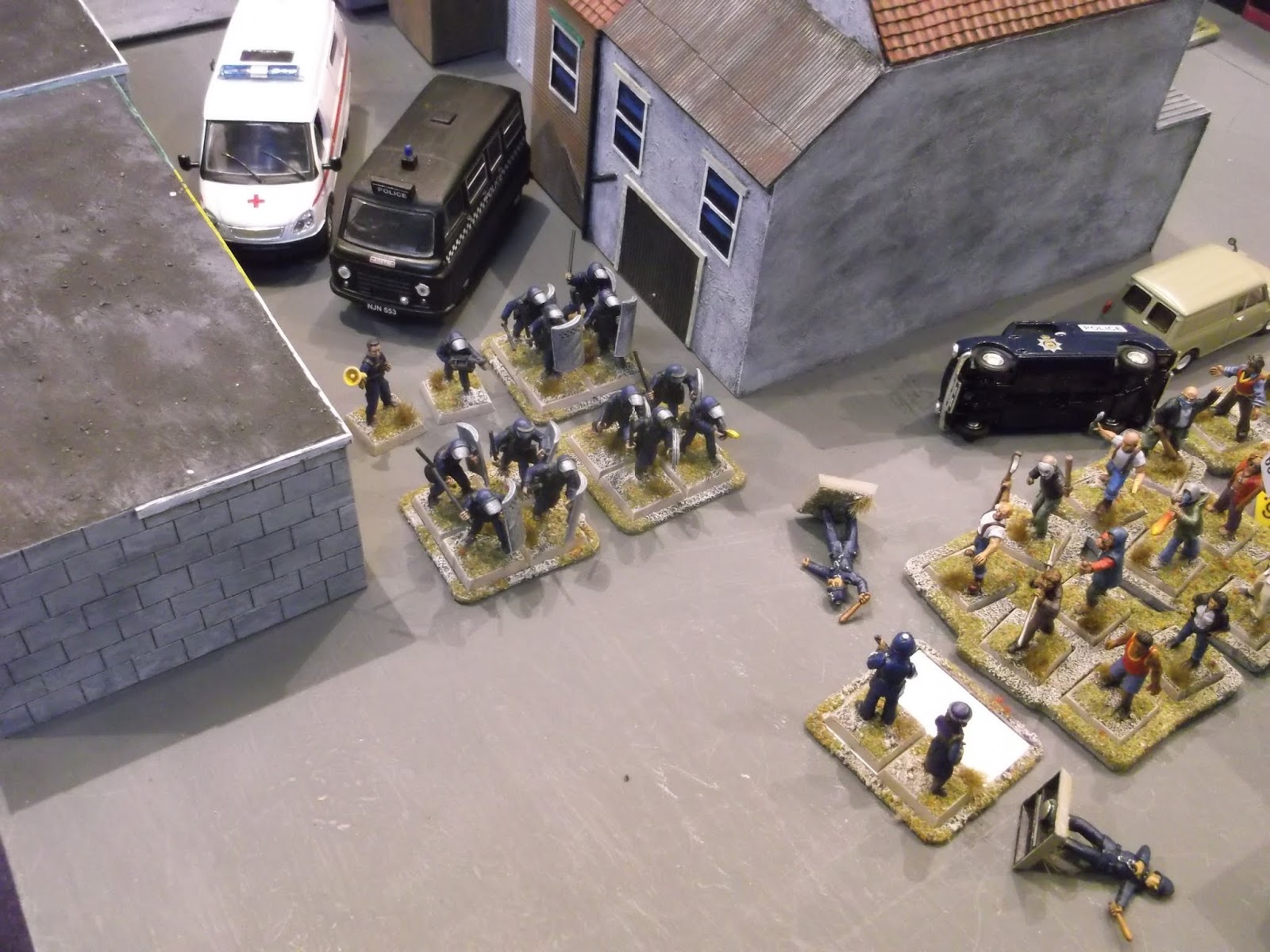
The middle group massively outnumbered their opponents and drove them back, injuring two 
officers.

The SL decided that this was the time to call out the riot squad.


They piled in pretty successfully, driving the rioters back. Charging riot-trained officers and tear gas combo is very effective.


The medic saw to one of the injured policemen. That 6 meant he unfortunately didn't make it. Dave was on hand to witness it, and no doubt the story of the officer's death will be in the local paper the next day.